


From the Book Jacket:
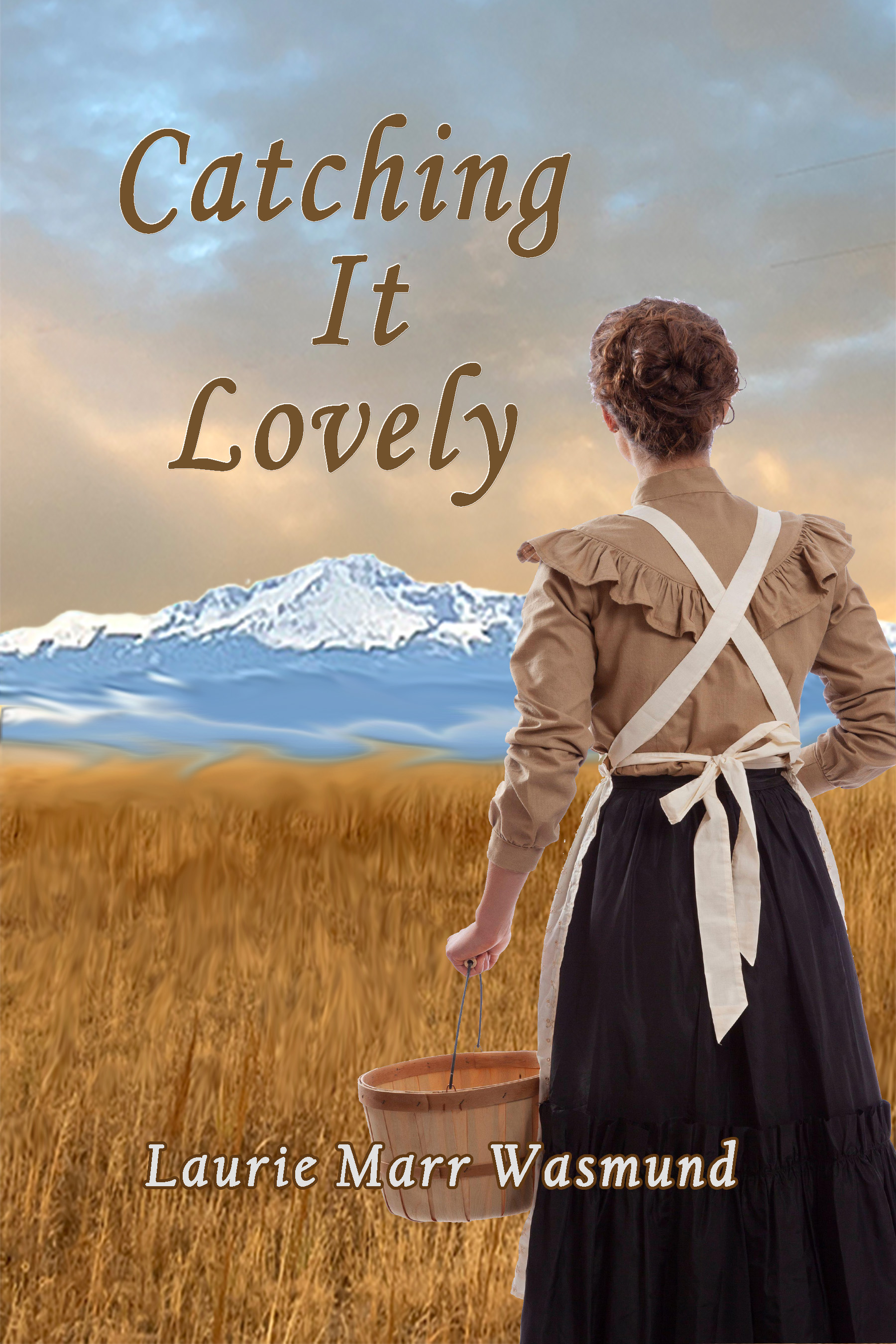
I was born Jane Morton in Arbilot, Scotland, in 1841, but that is not who I am or where I stayed.
So begins the story of an extraordinary journey from the green fields of Scotland, through fire-ravaged Chicago, to the untamed prairies of Colorado. Relying on historical research and family stories, award-winning author Laurie Marr Wasmund has brought to life the tale of her indomitable great-great-grandmother, Jane Morton Scott.
Determined to escape a life in drudgery in Arbroath, Scotland, Jane yearns for a new life in America. When she marries widower Alexander Scott, her dreams of immigrating to America take flight. After tragedy strikes, Alex, Jane, and their young family set off to Colorado Territory, where opportunity is rich, land is plentiful, and everything seems possible.
Sources for Catching It Lovely
I mentioned some sources in the Author’s Note in the book. This is a more complete list of the research I did to write this novel.
Scotland:
- A Topical Dictionary of Scotland by Samuel Lewis, 1846
- History of Arbroath, to the Present Time by George Hay, 1899
- Electric Scotland, a website filled with oddities and information about the country
Chicago:
- The Chicago Tribune online archives
- “Firestarter” by Margaret Talbor, The New Yorker, October 9, 2023
- “Chicago on Fire,” American Experience, PBS
The Denver & Rio Grande Railroad:
- “How the West Was Built: Drama and Danger Along General William J. Palmer’s Denver and Rio Grande Railroad,” Thesis by Philip DeHudy, Fort Lewis College
- “Tied to the Tracks” by Adam Gopnik, The New Yorker, June 28, 2021
Denver and Castle Rock, Colorado:
- Castle Rock Journal, Colorado Historic Newspaper Collection
- “The Instant City—The Gold Rush and Early Settlement, 1858-1892,” Historic Denver
- Colorado Encyclopedia
- Walk With Our Pioneers: A Collection by Alice M. Thompson
General Sources:
- Pioneer Women: Voices from the Kansas Frontier by Joanna L. Stratton
- Love Song to the Plains by Mari Sandoz
Ancestry.com:
Many thanks to Sonia in New Zealand, Karen and Lizbeth in Scotland, and Jerry in Denver for filling in gaps in the family history.
The Amazing Scott Brothers
While Jane Morton’s siblings and Alex Scott’s sisters mostly stayed in Arbroath and Scotland, Alex’s brothers traveled. Although I was unable to trace the movements of all six, I was lucky enough to find information about James (the eldest) and Robert.
James Scott followed his brother Alex to the United States—a fact that I do not touch upon in Catching It Lovely, which I considered Jane’s story. James came to the U.S. aboard the same vessel as Jane, the SS Iowa. While she traveled early in 1867, James arrived at Castle Garden in 1871. Like Alex, he came to America alone, without his wife and four children. Much like Jane, Mary Lundie Scott and Elizabeth (6), Isabelle (5), Andrew (2), and Alex (1) immigrated in September of 1872, arriving aboard the ship Australia. Mary Lundie had been a flax mill spinner in Arbroath, Scotland.
A machinist like his brother Alex, James worked his way west on both the Kansas & Pacific Railway and the Denver & Rio Grande, which “swapped” workers as needed. By 1874, the family was living in Denver. Soon a raft of daughters was born—Jemima (1875), Aggie (1878), Daisy (1879), and Pearl (1881). Perhaps that is why the Castle Rock Journal reports that James visited his brother Alex on the homestead in Castle Rock in 1880 “for the benefit of his health.” James and Mary Lundie would have one more child, a daughter named May, who is buried in Riverside Cemetery in Denver with her mother and father. I suspect that May was born in 1885, for that is when Mary Lundie died.
Most of James’s children moved as adults to the West Coast, spread from Portland, Oregon to L.A. A notable exception was Andrew Lundie Scott. After getting a start selling milk from a wagon, he opened a grocery store at 32nd and Gilpin. Later, Scott’s Market moved to 31st and Williams. The building deteriorated and was torn down as the area experienced gentrification, but Andrew’s 1912 mansion at 20th and Gaylord still stands as a historic home in Denver.
Robert Scott, Alex’s younger brother, became a ship’s carpenter and lived in Dundee, Scotland. He caused quite a stir in the Castle Rock Journal in 1895 when he visited Alex and Jane at the homestead. The two brothers had not seen each other in thirty years, but Robert’s sojourn wasn’t a family reunion. He had taken ill on board the Dona Francisco while sailing from London to Portland, OR. After seven weeks in the hospital, he arrived in Colorado to convalesce. After his stay, the newspaper continued to follow him for a while. It reported that he had returned to Liverpool after a four-month run from San Francisco. He would soon set sail for Philadelphia and then to Calcutta.
By 1896, the newspaper reported that Robert was captain of the Dunstaffnage, which arrived in Calcutta after a voyage of 108 days. After unloading, it was waiting for a cargo of jute for the mills of Dundee.
Alex’s story was not yet finished. After Jane’s death in December 1905 (spoiler alert), Alex took a third wife on November 29, 1906. Her name was Susan Clark Tappan Frost. Married in 1868 to William Frost Orville Frost Jr. in New York, she soon gave birth to Lewis Tappan Frost, known as “Jack.” (I’ve noted the similarity in name to Lewis Tappan, writer and abolitionist, and Lewis Northey Tappan, a Colorado pioneer, but I have not yet found the connection.) Susan lost her husband, William, in 1884, and by 1898, she and her mother were living in Denver.
A hint of scandal surrounds Susan’s marriage to Alex. Her son, Jack Frost, married Jemima Scott, the daughter of James Scott and Mary Lundie and Alex’s niece, in 1897. One wonders if Alex had eyes for Susan before Jane’s death. In 1909, Alex and Susan took an extended trip to Scotland, which Alex had left 42 years before, and New York. They returned to her home in the University Park area of Denver later that year. She would outlive Alex, who died in 1921 at the age of 80.
 Laurie Marr Wasmund